The Norwood Scale Explained: Find Your Stage of Hair Loss (2026)
3,031 words·Compiled from cited medical literature·Not medical advice
On this page 10 sections
The complete guide to understanding and using the classification system doctors use for male pattern baldness
Who This Guide Is For#
This guide is designed for you if:
- You want to understand where you fall on the hair loss spectrum
- You're trying to determine if changes you're seeing are normal or significant
- You're researching treatment options and want to know what applies to your stage
- You're considering a hair transplant and need to understand candidacy
- You want to track your hair loss progression objectively
This guide may not be ideal if:
- You're female (the Ludwig scale is used for female pattern hair loss)
- You're experiencing patchy, non-patterned hair loss (different conditions)
- You've already consulted with a specialist and have a treatment plan
- You're looking for detailed treatment protocols (covered elsewhere)
- You're under 18 and experiencing normal hairline maturation
What Is the Norwood Scale?#
History and Purpose#
The Norwood scale—officially the Norwood-Hamilton scale—is the standard classification system used worldwide to measure male pattern baldness. Dr. James Hamilton created the original classification in the 1950s, and Dr. O'Tar Norwood refined it in 1975 after studying 1,000 Caucasian men.
The scale serves several purposes:
Clinical communication: Doctors, surgeons, and patients share a common language. "Norwood 4" means the same thing to a dermatologist in New York and a hair transplant surgeon in Istanbul.
Treatment planning: Different stages respond to different treatments. Knowing your stage helps determine whether medication alone makes sense or surgical intervention is warranted.
Progress tracking: The scale provides benchmarks for monitoring progression. Moving from Stage 3 to Stage 4 is measurable and meaningful.
Realistic expectations: Understanding the typical pattern helps set appropriate expectations for treatment outcomes.
The Scale's Limitations#
The Norwood scale, while useful, has acknowledged limitations:
Subjective assessment: Different examiners may classify the same patient differently. There's inherent variability in visual assessment.
Doesn't capture rate: The scale shows where you are, not how fast you're progressing. A stable Norwood 3 is different from a rapidly progressing Norwood 3.
Pattern variations: Not everyone follows the typical pattern. The Type A variant represents a different progression pattern not fully captured by standard staging.
Ethnic considerations: The scale was developed studying Caucasian men. Pattern presentations may vary in other ethnic groups.
Despite these limitations, the Norwood scale remains the most widely used and clinically useful classification system available.
The 7 Stages Explained#
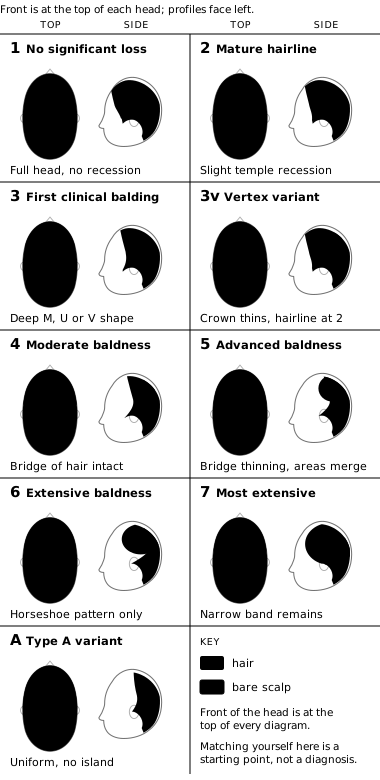
Stage 1 - No Significant Hair Loss#
What it looks like: Full head of hair with no visible recession or thinning. The hairline retains its juvenile form—typically straight across or with a slight widow's peak.
Clinical significance: Stage 1 isn't balding—it's the baseline against which other stages are measured. If you're at Stage 1, you either have no genetic predisposition to pattern baldness or it hasn't started yet.
Treatment considerations: No treatment is needed. If you have family history of pattern baldness, this is the time for awareness and potentially preventive measures—but medication at this stage is generally not recommended.
What to watch for: Any recession at the temples, even if subtle. Changes are easier to address early.
Stage 2 - The Mature Hairline#
What it looks like: Slight recession at the temples, creating a gentle M-shape. The mid-frontal hairline remains relatively intact. The recession is typically 1-2 centimeters from the juvenile hairline.
Clinical significance: Dr. Hamilton originally classified Stage 2 as "not balding." For most men, this represents normal hairline maturation that occurs between ages 17-30. The mature hairline is stable and doesn't indicate progressive loss.
The key question: Is this a stable mature hairline or early pattern baldness? The distinction matters:
- Mature hairline: Stabilizes and doesn't progress further
- Early pattern baldness: Continues receding over time
Photo documentation over 6-12 months is the most reliable way to distinguish between them.
Treatment considerations: No treatment needed for a stable mature hairline. If you're seeing progressive recession, preventive medication (finasteride, minoxidil) may be appropriate—but consult a specialist first.
Stage 3 - First Clinical Balding#
What it looks like: Deep recession at the temples creating a pronounced M, U, or V shape. The recessed areas are largely bare or very sparsely covered. This is unmistakably different from a mature hairline.
Clinical significance: Stage 3 is the first stage that qualifies as clinical balding. The recession has gone beyond normal maturation into pathological hair loss.
Stage 3 Vertex variant: Some men experience thinning at the crown (vertex) while the hairline remains at Stage 2. This is classified as "Stage 3 Vertex" and also represents clinical balding.
Treatment considerations: Stage 3 is the sweet spot for treatment:
- Medications: Finasteride and minoxidil are highly effective at this stage
- Hair transplant: Stage 3 patients show the highest satisfaction rates (98%) with hair transplantation
- Combination therapy: Medication plus transplant often provides optimal results
- Graft estimate: Typically 1,500-2,500 grafts for full restoration
Stage 4 - Moderate Baldness#
What it looks like: More severe hairline recession than Stage 3, with established thinning or baldness at the crown. A band of hair (the "bridge") separates the frontal recession from the crown baldness.
Clinical significance: Stage 4 represents moderate, clearly visible baldness. Hair loss is obvious to others and typically affects self-image.
Treatment considerations:
- Medications: Still beneficial, especially for maintaining existing hair and slowing progression
- Hair transplant: Excellent candidate—good balance of available donor hair and achievable restoration
- Graft estimate: 3,000-4,000 grafts typically needed
- Realistic expectations: Full density restoration may not be achievable, but significant improvement is possible
Stage 5 - Advanced Baldness#
What it looks like: The bridge of hair between the frontal area and crown is thinning significantly. The two bald areas are beginning to merge. Hair loss is extensive and obvious.
Clinical significance: Stage 5 represents advanced baldness where the characteristic pattern is fully established.
Treatment considerations:
- Medications: Benefit is limited—mostly for maintaining what remains
- Hair transplant: Still viable, but donor hair becomes a limiting factor
- Graft estimate: 3,500-5,000 grafts, possibly requiring multiple sessions
- Realistic expectations: Full coverage unlikely; strategic restoration focusing on frontal area often provides best aesthetic outcome
Stage 6 - Extensive Baldness#
What it looks like: The bridge is gone. The frontal baldness has merged with the crown baldness, leaving only a horseshoe pattern of hair around the sides and back.
Clinical significance: Stage 6 is extensive baldness with limited remaining hair on top of the scalp.
Treatment considerations:
- Medications: Minimal benefit for restoration; may help maintain remaining hair
- Hair transplant: Possible but limited by available donor hair
- Graft estimate: 4,000-6,000+ grafts, often requiring multiple sessions
- Alternative approaches: Scalp micropigmentation may be considered; some patients opt to embrace baldness
- Realistic expectations: Cannot achieve full coverage; focus on improving appearance rather than complete restoration
Stage 7 - Most Extensive Baldness#
What it looks like: Only a narrow band of hair remains around the sides and back of the head. The remaining hair may be fine and sparse.
Clinical significance: This is the most advanced stage of pattern baldness, representing the end-point of the typical progression pattern.
Treatment considerations:
- Medications: Essentially no benefit for hair on top of scalp
- Hair transplant: Significantly limited by donor availability; may require beard or body hair
- Graft estimate: Varies widely; multiple sessions typically needed; full coverage impossible
- Alternative approaches: Scalp micropigmentation, hair systems, or embracing baldness
- Realistic expectations: Hair transplant can improve appearance but cannot restore a full head of hair
The Type A Variant#
Understanding the Different Progression Pattern#
Approximately 15-20% of men with pattern baldness follow the Type A progression pattern, which differs from the typical pattern in important ways:
Uniform recession: Instead of deep temple recession with a preserved island of hair in the middle, the hairline recedes uniformly from front to back.
No separate vertex baldness: Unlike the typical pattern where vertex thinning develops independently, Type A doesn't show isolated crown involvement.
Appearance: The hairline looks like it's being pushed backward evenly, rather than creating an M or V shape.
Staging: Type A has its own classification (1A through 5A), though the principles remain similar. Stage 5A represents complete frontal baldness without the horseshoe pattern.
Treatment implications: Type A patients may have different graft distribution needs for hair transplant. The uniform recession can be easier to address surgically in some ways.
How to Determine Your Stage#
Self-Assessment Method#
While professional evaluation provides the most accurate staging, you can perform a reasonable self-assessment:
Step 1 - Prepare your environment:
- Find good lighting, preferably natural daylight
- Use a mirror (or two mirrors for seeing the back)
- Have your phone camera ready for photos
- Wash and dry your hair normally—no styling products
Step 2 - Examine from multiple angles:
- Front view: Look at hairline shape and temple recession
- Top view: Check crown/vertex area for thinning
- Side views: Assess recession depth from both sides
- Back view: Check if you can see any thinning at crown
Step 3 - Document with photos:
- Take photos from each angle
- Use the same lighting and distance each time
- Date your photos for comparison
- Compare to Norwood scale reference images
Step 4 - Assess specific features:
- How far have your temples receded? (measure from juvenile hairline if known)
- Is there thinning at the crown?
- Is there a "bridge" of hair connecting front and crown?
- Can you see scalp through your hair?
Step 5 - Compare to reference images:
- Match your pattern to standard Norwood scale images
- Remember you may fall "between" stages
- Note which features match and which don't
Mature Hairline vs. Early Balding#
This distinction is crucial for Stage 2 assessment:
Signs it's a mature hairline (normal):
- Recession is 1-2 cm maximum
- Mid-frontal hairline remains strong
- No miniaturization (thin, weak hairs) at temples
- No progression over 12+ months
- Stabilized between ages 17-30
Signs it's early pattern baldness:
- Recession exceeds 2 cm
- Visible miniaturization at recession points
- Continuing to progress over months
- Crown also showing early thinning
- Family history of significant baldness
When in doubt: Track with photos for 6-12 months. Progression confirms pattern baldness; stability suggests mature hairline.
Treatment Implications by Stage#
Medication Candidates#
Best candidates (Stages 1-4):
- Finasteride: Most effective for maintaining existing hair and promoting regrowth
- Minoxidil: Stimulates growth, effective across all stages but best results early
- Combination therapy: Often more effective than either alone
Limited benefit (Stages 5-7):
- May slow progression of remaining hair
- Won't regrow extensively bald areas
- Can help maintain transplanted hair
Hair Transplant Candidates#
Ideal candidates (Stage 3):
- Sufficient hair loss to justify surgery
- Abundant donor hair available
- 98% patient satisfaction at this stage
- Best balance of need and resources
Good candidates (Stages 4-5):
- Clear indication for surgery
- Good donor hair typically available
- Realistic expectations important
- May need multiple sessions
Limited candidates (Stages 6-7):
- Donor hair becomes limiting factor
- Cannot achieve full coverage
- Strategic restoration (frontal focus) often best approach
- May need supplementary approaches (SMP, systems)
The Role of Staging in Treatment Planning#
Understanding your stage helps answer key questions:
"Should I start medication?"
- Stages 1-2: Preventive consideration if progressing
- Stages 3-4: Yes, can make significant difference
- Stages 5-7: Limited benefit, but may help maintain what remains
"Am I a good transplant candidate?"
- Stages 1-2: Generally not—wait and monitor
- Stage 3: Ideal timing if desiring restoration
- Stages 4-5: Good candidates with realistic expectations
- Stages 6-7: Possible but limited by donor hair
"What results can I expect?"
- Earlier stages: Near-complete restoration possible
- Later stages: Significant improvement, but full coverage unlikely
Tracking Progression#
Monitoring Your Stage Over Time#
Hair loss progression varies dramatically between individuals. Some men remain at Stage 3 for decades; others progress rapidly to Stage 6 within a few years. Tracking helps you:
Detect progression early: Monthly or quarterly photos reveal changes invisible day-to-day.
Evaluate treatment effectiveness: Is medication maintaining your stage or slowing progression?
Time surgical decisions: Some surgeons recommend waiting until progression stabilizes before transplant.
Adjust expectations: Understanding your progression rate helps predict where you might be in 5-10 years.
Documentation Protocol#
Monthly: Quick phone photos from front and top Quarterly: Full photo set (front, both sides, top, back) in consistent lighting Annually: Professional evaluation if concerned or considering treatment Comparison: Side-by-side comparison of photos from same angle, 6-12 months apart
Beyond the Norwood Scale#
Other Classification Systems#
While Norwood is standard for men, other systems exist:
Ludwig Scale: Used for female pattern hair loss, measuring diffuse thinning severity (Grades I-III)
Sinclair Scale: Alternative female pattern scale with 5 stages
Savin Scale: Measures female hair loss density
Basic and Specific (BASP) Classification: More detailed system incorporating both pattern and severity
When Professional Evaluation Matters#
Self-assessment provides a starting point, but professional evaluation is important when:
- You're considering hair transplant surgery
- You want to start medication and need prescription
- You're uncertain about your stage or progression
- Your pattern doesn't fit typical descriptions
- You need formal documentation for treatment planning
Dermatologists and hair restoration specialists can provide accurate staging, trichoscopy examination (magnified scalp analysis), and evidence-based treatment recommendations.
Frequently Asked Questions#
Is Stage 2 actually balding?#
Usually not. Dr. Hamilton originally classified Stage 2 as "not bald." Most men develop a slight temple recession as they transition from a juvenile to mature hairline between ages 17-30. However, Stage 2 can be the starting point for progressive pattern baldness—tracking over time distinguishes stable mature hairlines from progressing hair loss.
Can you move backward on the Norwood scale?#
With successful treatment (medication or transplant), you can improve the appearance of your hair, but you don't truly reverse your "native" stage. Transplanted hair fills in areas that were bald; medication can thicken existing hair and promote regrowth in recent loss areas. Without ongoing treatment, progression typically resumes.
How fast does progression happen?#
Highly variable. Some men stay at Stage 3 for 20+ years. Others progress from Stage 3 to Stage 6 within 5 years. Younger onset typically means faster progression. Family history provides clues but doesn't guarantee a specific pattern.
At what stage should I start treatment?#
Stage 3 is when clinical balding begins and treatment has the most to offer. However, earlier intervention (Stage 2 with progression) can prevent reaching Stage 3. The earlier you start medication, the more hair you have to maintain.
What's the best stage for a hair transplant?#
Stage 3 shows the highest satisfaction rates (98%), offering the ideal balance of sufficient loss to justify surgery and abundant donor hair for restoration. Stages 4-5 are also good candidates. Later stages are more challenging due to donor hair limitations.
Does the scale apply to all ethnicities?#
The scale was developed studying Caucasian men, and pattern presentations may vary somewhat by ethnicity. However, the basic progression pattern applies broadly. Asian men may show more temple recession with less vertex involvement; African-American men may show variations in pattern density.
Can I determine my future stage from family history?#
Family history provides clues but not certainty. If your father and maternal grandfather both reached Stage 6, you're at higher risk—but genetics are complex and you may follow a different pattern. The genes come from both parents, and expression varies.
What if I don't fit neatly into one stage?#
Many men fall between stages or have features of multiple stages. It's common to have temple recession of one stage and vertex involvement of another. Describe your pattern honestly rather than forcing a single stage number.
The Bottom Line#
The Norwood scale provides a common language for understanding and communicating about male pattern baldness. Knowing your stage helps guide treatment decisions, set realistic expectations, and track progression over time.
Key takeaways:
- Stage 2 is usually a mature hairline, not balding
- Stage 3 marks the first clinical balding and is ideal for intervention
- Stages 1-4 respond well to medication
- Stages 3-7 may be candidates for hair transplant, with earlier stages showing better outcomes
- Track your progression with regular photos
- Professional evaluation provides the most accurate staging and treatment guidance
Whether you're trying to determine if you're actually balding, considering treatment options, or tracking your progression, understanding the Norwood scale gives you the framework to make informed decisions.
References
- PMC - Classification of Male-pattern Hair Loss
- Wikipedia - Hamilton-Norwood Scale
- Healthline - Norwood Scale
- Bosley - Norwood Scale Guide
- Smile Hair Clinic - Norwood Scale Stages 1-7
- Dental Hair Clinic Turkey - Graft Requirements
- Solve Clinics - Norwood Scale
- Wimpole Clinic - Norwood Scale Guide
- Hims - 7 Stages of Male Pattern Baldness
- Natural Transplants - Norwood Hamilton Scale
Medical Disclaimer: This article is for informational purposes only and does not constitute medical advice. Hair loss classification requires professional evaluation. Consult a dermatologist or hair restoration specialist for accurate staging and personalized treatment recommendations.