Female Pattern Hair Loss: Treatment Options That Work
2,858 words·Compiled from cited medical literature·Not medical advice
On this page 12 sections
- Who This Is For
- Understanding Female Pattern Hair Loss
- First-Line Treatment: Topical Minoxidil
- Second-Line Treatment: Antiandrogens
- Emerging Treatment: Low-Dose Oral Minoxidil
- Procedural Treatment: Platelet-Rich Plasma (PRP)
- Device Treatment: Low-Level Laser Therapy
- Surgical Treatment: Hair Transplantation
- Building Your Treatment Plan
- Timeline for Results
- Frequently Asked Questions
- Related Resources
Who This Is For#
This guide is for you if:
- You've been diagnosed with female pattern hair loss (FPHL)
- You want detailed information about available treatments
- You're not responding to current treatment and want alternatives
- You're considering adding treatments to your regimen
- You want to understand the evidence behind treatment options
This guide is NOT for you if:
- You haven't been diagnosed—see our women's hair loss overview first
- Your hair loss is from a different cause (telogen effluvium, alopecia areata)
- You're looking for general hair loss information rather than specific treatments
- You're pregnant or planning pregnancy (some treatments are contraindicated)
Understanding Female Pattern Hair Loss#
What Makes FPHL Different#
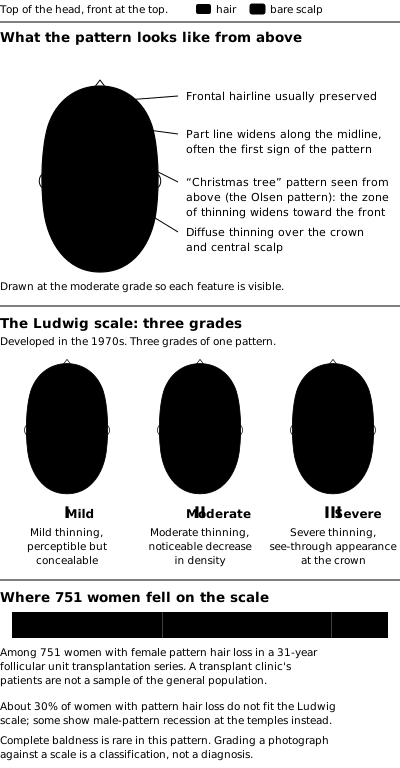
Female pattern hair loss, also called female androgenetic alopecia, is the most common cause of hair loss in women. Unlike male pattern baldness which often leads to complete baldness in affected areas, FPHL typically causes progressive thinning over the crown and central scalp while preserving the frontal hairline.
Key characteristics:
- Diffuse thinning primarily over crown/part area
- Widening of the part line (often the first sign)
- "Christmas tree" pattern when viewed from above
- Usually preserves the frontal hairline
- Rarely leads to complete baldness
Ludwig Classification:
- Grade I: Mild thinning, perceptible but concealable
- Grade II: Moderate thinning, noticeable decrease in density
- Grade III: Severe thinning, see-through appearance at crown
The treatment approach often depends on your Ludwig grade and how long you've had noticeable hair loss.
First-Line Treatment: Topical Minoxidil#
The Foundation of FPHL Treatment#
Topical minoxidil is the only FDA-approved treatment for female pattern hair loss. It remains the first-line therapy for good reason—decades of evidence support its safety and efficacy.
How it works: Minoxidil extends the growth phase of hair (anagen) and increases blood flow to hair follicles. It also enlarges miniaturized follicles. The exact mechanism isn't fully understood, but the clinical results are well-documented.
Efficacy data: Research shows that after 6-12 months of use:
- Approximately 90% of women experience disease stabilization (slowing or stopping progression)
- 46-68% see actual hair regrowth
- About 40% are "non-responders" who don't see meaningful improvement
Available concentrations:
- 2% solution (FDA-approved for women): Apply 1 ml twice daily
- 5% foam (off-label but commonly used): Apply once daily
- Clinical trial data shows 5% is statistically superior to 2% (P = .031 at week 48), though with slightly more side effects
Important considerations:
- Requires at least 12 months commitment before assessing efficacy
- Must be used continuously—stopping causes gradual loss of benefits
- Initial shedding in first 2-8 weeks is normal and actually indicates response
- Hypertrichosis (facial hair growth) can occur, especially with 5%—careful application technique helps
For detailed minoxidil guidance, see our Minoxidil for Women Guide.
Setting Realistic Expectations#
It's essential to understand what minoxidil can and cannot do:
What minoxidil CAN do:
- Slow or stop further hair loss
- Regrow some lost hair (cosmetically significant improvement in many patients)
- Maintain results long-term with continued use
What minoxidil CANNOT do:
- Restore a full head of hair to someone with advanced loss
- Work for everyone (about 40% are non-responders)
- Provide permanent results (effects reverse if stopped)
- Work immediately (takes 4-6 months minimum for visible results)
Second-Line Treatment: Antiandrogens#
Spironolactone for FPHL#
For women with inadequate response to minoxidil alone, antiandrogen therapy—particularly spironolactone—can significantly improve outcomes.
How spironolactone works: Spironolactone is an aldosterone antagonist that also blocks androgen receptors and reduces androgen production. Since androgens (specifically DHT) contribute to follicle miniaturization in FPHL, blocking their effects can slow or reverse the process.
Evidence for effectiveness: A 2025 randomized, double-blind, placebo-controlled study demonstrated that spironolactone 100 mg daily added to topical minoxidil produced:
- 38% moderate-to-marked improvement vs 9% with placebo (P = .034)
- This represents significant additional benefit beyond minoxidil alone
Earlier research shows:
- Combination therapy (spironolactone + minoxidil): 65.80% improvement
- Spironolactone monotherapy: 43.21% improvement
Dosing:
- Typical range: 50-200 mg daily
- Important: Doses below 100 mg are often ineffective for hair loss
- Long-term use (>12 months) at 100-200 mg may be required for optimal results
Side effects:
- Menstrual irregularities (37.5% in clinical trials)
- Fatigue, mastalgia (breast tenderness)
- Lightheadedness, headache
- Hyperkalemia risk (rare in healthy young women, but requires monitoring)
Important warnings:
- NOT safe during pregnancy—can feminize male fetuses
- Requires reliable contraception
- May need potassium monitoring, especially if taking other medications
Other Antiandrogen Options#
Finasteride: A 5-alpha-reductase inhibitor that blocks conversion of testosterone to DHT. Used off-label in women at higher doses (2.5-5 mg) than men. Some evidence of efficacy, but:
- Absolutely contraindicated in pregnancy
- Less studied in women than spironolactone
- May be more effective in postmenopausal women
Cyproterone acetate: Not available in the United States but used in other countries. Combined antiandrogen and progestin effects.
Flutamide: Rarely used due to hepatotoxicity risk. Reserved for carefully selected cases with close monitoring.
Emerging Treatment: Low-Dose Oral Minoxidil#
A New Option for FPHL#
Low-dose oral minoxidil (LDOM) is emerging as an important alternative for women who cannot tolerate or have failed topical minoxidil.
Evidence: The largest study to date followed 148 women with FPHL treated with LDOM. Results showed:
- Effective treatment with good safety profile
- Higher response rates in more advanced stages of FPHL
- Comparable efficacy to topical formulations at very low doses
A separate study found no significant difference in efficacy between 0.25 mg oral minoxidil daily and 1 ml of 2% topical minoxidil twice daily.
Dosing:
- Typical range for FPHL: 0.25-1.25 mg daily
- Much lower than historical cardiovascular doses (10-40 mg)
- Most commonly prescribed: 0.625 mg or 1.25 mg daily
Safety data (1,404-patient multicenter study):
- Most common side effect: Hypertrichosis (15.1%)
- Systemic effects: Lightheadedness (1.7%), fluid retention (1.3%), tachycardia (0.9%)
- Drug discontinuation rate: Only 1.2%
- Minimal changes in blood pressure in FPHL patients
Who is LDOM best for?
- Women who can't tolerate topical minoxidil (irritation, sensitivity)
- Women who find topical application inconvenient or impractical
- Women who prefer oral medications
- Patients not responding to topical minoxidil alone
Important considerations:
- Not FDA-approved for hair loss
- Rare but serious cardiovascular complications have been reported
- Should be prescribed by a physician experienced with this use
- May require baseline cardiovascular assessment in some patients
Procedural Treatment: Platelet-Rich Plasma (PRP)#
PRP for Female Hair Loss#
Platelet-rich plasma (PRP) therapy has gained popularity as a minimally invasive treatment option for FPHL.
How it works: PRP involves drawing the patient's blood, concentrating the platelets through centrifugation, and injecting the platelet-rich fraction into the scalp. Platelets contain growth factors that may stimulate hair follicles.
Evidence: A 2024 systematic review and meta-analysis of 21 studies (628 participants) found:
- PRP effectively enhances hair density and thickness in women
- Effects vary with dosage, injection duration, and ethnicity
- Favorable safety profile
A comprehensive 2021 meta-analysis (42 studies, 776 female participants) concluded:
- PRP shows excellent efficiency through hair density evaluation
- Can be used in combination with topical/oral treatments
- May help patients who didn't respond to or tolerate minoxidil
Reported results:
- 64% of patients report improvement in hair density
- 57% report new hair growth
- 46% improvement in hair quality
- High satisfaction scores overall
Protocol:
- Typically 3+ sessions at monthly intervals
- Maintenance sessions every 3-6 months may be needed
- No standardized protocol exists (varies by provider)
Considerations:
- Not FDA-approved for hair loss
- Significant cost ($500-2,000+ per session)
- Results are variable
- Quality of preparation affects results
- Best as adjunct to medical therapy, not standalone treatment
For detailed information, see our PRP for Hair Loss Guide.
Device Treatment: Low-Level Laser Therapy#
LLLT for FPHL#
Low-level laser therapy (LLLT), also called red light therapy or photobiomodulation, uses specific wavelengths of light to stimulate hair follicles.
Evidence: FDA-cleared LLLT devices have demonstrated efficacy in clinical trials:
- All sham-device controlled studies showed statistically significant increases in hair diameter or density (p < 0.01)
- One study showed 51% increase in terminal hair counts compared to sham device in women
- LLLT and topical minoxidil showed similar efficacy in some studies
- Combination (LLLT + minoxidil) was even more effective than either alone
A key clinical trial: 141 female subjects were randomized to HairMax LaserComb or sham device, used 3 times per week for 26 weeks. Treatment resulted in statistically significant terminal hair density increase.
Available devices:
- Laser combs (HairMax FDA-cleared)
- Laser caps/helmets
- In-office panels
Safety:
- Excellent safety profile
- Only minor adverse effects reported
- Non-invasive
Who is LLLT best for?
- Patients wanting to add a drug-free option
- Those who can't tolerate medications
- As adjunct to topical minoxidil for enhanced results
- Patients with mild-moderate FPHL
Considerations:
- Requires consistent, long-term use (3x per week typically)
- Cost varies widely ($200-3,000+ for home devices)
- Results take 3-6 months to become apparent
- Best evidence for FDA-cleared devices
Surgical Treatment: Hair Transplantation#
When Transplant Is an Option#
Hair transplantation can provide excellent results for carefully selected women with FPHL, but candidacy criteria are stricter than for men.
Ideal female candidates:
- High hair density in the donor area (occipital scalp)
- Extensive hair loss in a defined pattern (not diffuse global thinning)
- Stable hair loss (not rapidly progressing)
- Realistic expectations
Who is NOT a good candidate:
- Women with diffuse unpatterned alopecia (DUPA)—global thinning including donor area
- Unstable hair loss (rapidly progressing)
- Insufficient donor density
- Unrealistic expectations
- Untreated medical conditions affecting hair
The key challenge for women: Unlike men who typically have stable donor areas that remain unaffected by DHT, many women experience global reduction in density throughout the scalp—including the donor area. Transplanting hairs from a thin donor area to another thin area produces poor results.
Results data: A 31-year study of 751 women with FPHL who underwent follicular unit transplantation (FUT) found:
- Average patient age: 48 years
- 40% were Ludwig I, 45% Ludwig II, 15% Ludwig III
- Results take up to 6 months to become evident
- 1-3 sessions typically needed, spaced 6 months apart
- 800-1,200 grafts per session typically
Procedure considerations:
- FUT (strip method): Leaves linear scar, but no recipient shaving needed
- FUE (extraction method): Individual follicle extraction, no linear scar
- Expect results at 6-12 months post-procedure
- Medical treatment (minoxidil/spironolactone) often continued post-transplant
Building Your Treatment Plan#
A Step-by-Step Approach#
Step 1: First-Line Therapy (Months 0-12) Start with topical minoxidil:
- 2% solution twice daily (FDA-approved), OR
- 5% foam once daily (commonly used, slightly more effective)
- Commit to minimum 12 months before assessing full effect
- Expect some initial shedding—this is normal
Step 2: Assess Response (Month 12) Evaluate results through:
- Comparison photos (same lighting, angle)
- Hair count or density measurements if available
- Subjective assessment of volume and coverage
Step 3: If Inadequate Response (Months 12-24)
Option A: Add spironolactone
- Start 100 mg daily (lower doses less effective)
- May increase to 150-200 mg if tolerated
- Requires contraception; monitoring if indicated
- Continue topical minoxidil
Option B: Switch to oral minoxidil
- Consider if topical causes irritation or is impractical
- 0.25-1.25 mg daily
- Discuss cardiovascular considerations with physician
Option C: Add LLLT
- FDA-cleared device, 3x per week
- Use alongside medical therapy
- May enhance response to minoxidil
Step 4: Consider PRP (Months 18-24) If still inadequate response:
- Series of 3+ treatments, monthly
- Use alongside medical therapy
- May provide additional improvement in hair density
Step 5: Evaluate Transplant Candidacy (After 2+ Years) If medical therapy has maximized results but gaps remain:
- Get evaluation by experienced transplant surgeon
- Ensure donor area is adequate
- Continue medical therapy to protect existing hair
Combination Approaches#
Research supports combination therapy over single treatments:
| Approach | Improvement Rate |
|---|---|
| Spironolactone alone | 43.21% |
| Minoxidil + Spironolactone | 65.80% |
| LLLT alone | 51% increase vs sham |
| LLLT + Minoxidil | Better than either alone |
| Minoxidil + Spironolactone + LLLT | Potentially additive |
The principle: Different treatments work through different mechanisms. Combining them often produces better results than any single therapy.
Timeline for Results#
What to Expect and When#
Month 1-2:
- Possible increased shedding with minoxidil ("dread shed")
- No visible improvement yet
- Stay consistent with application
Month 3-4:
- Shedding typically resolves
- May notice less hair falling out
- Too early for visible regrowth
Month 6:
- First signs of improvement may appear
- Hair may feel thicker
- Existing hairs may be stronger
Month 12:
- Full assessment possible
- Maximum response to minoxidil typically reached
- Decide whether to continue, add, or change therapy
Month 12-24:
- Results from added treatments (spironolactone, LLLT) emerge
- PRP series if initiated shows results
- Continued optimization
Ongoing:
- Maintenance therapy required indefinitely
- Results lost if treatment stopped
- Periodic reassessment recommended
Frequently Asked Questions#
Which treatment should I start with?#
Topical minoxidil (2% or 5%) is the evidence-based first-line treatment. Start there unless you have specific reasons (allergies, irritation history) to consider alternatives.
Can I skip minoxidil and go straight to transplant?#
Generally not recommended. Medical therapy helps stabilize hair loss, and many women aren't good transplant candidates due to diffuse thinning patterns. Transplant works best after medical therapy has optimized results.
How long should I try a treatment before giving up?#
Minimum 12 months for topical minoxidil, 12+ months for spironolactone at adequate doses (100+ mg). Shorter trials may miss delayed responders.
Is oral minoxidil safer than topical?#
Not necessarily. Both have different side effect profiles. Topical causes local irritation and hypertrichosis; oral can have systemic cardiovascular effects, though rare at low doses. Choice depends on individual factors.
Does PRP work for everyone?#
No. Response varies significantly. It works best as an adjunct to medical therapy, not as standalone treatment. Results also depend on preparation quality and injection technique.
Will my hair loss return if I stop treatment?#
Yes, gradually. FPHL is progressive, and treatments slow or reverse the process while you're using them. Stopping allows progression to resume. Think of it like treating a chronic condition.
Can I use multiple treatments at once?#
Yes, and evidence suggests combination approaches often work better than single treatments. Common combinations: minoxidil + spironolactone, minoxidil + LLLT, medical therapy + PRP.
At what point should I consider a hair transplant?#
After 1-2 years of optimized medical therapy if you still have significant cosmetic concerns AND you're a suitable candidate (adequate donor density, localized pattern, stable loss).
Related Resources#
- Women's Hair Loss: Complete Guide
- Minoxidil for Women: Complete Guide
- PCOS Hair Loss: Management Guide
- Menopause and Hair Loss: What to Do
- PRP for Hair Loss Guide
- Low-Level Laser Therapy Guide
- Hair Transplant Guide
Medical Disclaimer
This information is for educational purposes only and is not a substitute for professional medical advice. Treatment for female pattern hair loss should be individualized based on your specific situation, medical history, and response to therapy. Consult a dermatologist or hair loss specialist before starting any treatment. Some medications discussed (spironolactone, finasteride) are not FDA-approved for hair loss and are absolutely contraindicated during pregnancy.
References
- Female-pattern hair loss: therapeutic update. PMC10334345.
- Efficacy and safety of oral spironolactone for FPHL in premenopausal women (2025 RCT). PMC12448166.
- Low-Dose Oral Minoxidil for Female Pattern Hair Loss: 148 Women. PMC7325226.
- Safety of low-dose oral minoxidil: Multicenter study of 1404 patients. PubMed 33639244.
- Effectiveness of PRP in treating female hair loss: Systematic review. PMC11342464.
- PRP in Female Androgenic Alopecia: Comprehensive systematic review. PMC8204330.
- Examining Safety and Efficacy of LLLT for Pattern Hair Loss. PMC7548873.
- Efficacy of Low-level Laser Device: Multicenter, randomized, double-blind study. PMC3986893.
- Is Every Patient a Candidate for Hair Transplant? PMC8719975.
- Clinical Features of Patients with Hair Transplants in FPHL. PMC11621641.